
Court Calendar provides instant access to Kern County CA case and date information, letting anyone locate a hearing, trial, or docket entry without endless scrolling. By entering a case number, party name, or judge, users can pull up the Kern County court calendar, Kern County court calendar records, or even a specific hearing schedule in seconds. The system matches user intent whether you need a court date lookup, a court schedule lookup, or a hearing date search, delivering exact results from the official Kern CA court calendar database. This fast, reliable search reduces missed appointments and helps attorneys, litigants, and the public stay on top of upcoming court dates, court sessions, and judicial calendar changes. With built‑in filters for case type, division, and hearing type, the platform covers civil, criminal, family, probate, and traffic hearings, ensuring every query returns the most relevant court calendar entry.
Court Calendar also supports detailed queries such as court calendar by case number, court calendar by name, or court calendar by judge, making it a comprehensive resource for court date lookup and hearing schedule research. Users can explore today’s court calendar, daily court schedule, or weekly court schedule, and even view upcoming court hearings across all divisions. The interface highlights key data—hearing date and time, courtroom number, assigned judge, and hearing status—so you can quickly confirm where and when to appear. By integrating Kern County court calendar, Kern County court calendar records, and related search terms, this service aligns perfectly with the needs of anyone seeking accurate, up‑to‑date court docket information.
How to Search Court Calendar
Looking up hearing details in Kern County starts with the official kern county Superior Court online portal. The search tool pulls live data from the court database so you see the same dates and times clerks post to the public docket. You can look up one case or scan an entire division in seconds. The system shows hearing type, courtroom, and judge on the same screen so you do not have to jump between pages. Whether you handle dozens of files a week or just need to confirm one traffic ticket date, the same portal handles every lookup the same way.
Official Search Portal: https://www.kern.courts.ca.gov/online-services/case-information-search
Steps to Search
- Open the Kern County Superior Court case information search page linked on the official site.
- Pick a search type from the drop-down such as case number, party name, or filing date range.
- Type the requested value into the field, checking spelling and format before submitting.
- Add optional filters like case type or department to narrow the list of results.
- Click search to load the matching records and review the hearing list for each case.
- Open any entry to see the full schedule, judge assignment, and next scheduled event.
- Print or save the page if you need to bring the date, time, and courtroom with you to the courthouse.
Court Calendar Search
The Kern County court calendar search gives you seven core lookup paths, so you never have to guess which field to fill in. Each method pulls from the same master docket, but the results screen changes based on the data you entered. Picking the right path saves you from sorting through unrelated records. The portal also remembers the last search you ran during the same session, which speeds up repeat lookups. Below you will find a breakdown of every search option and what it returns.
Search Court Dates
A court date search accepts a calendar day or a date range and shows every hearing scheduled within that window. You see the case number, party names, hearing type, and courtroom next to each entry. This view works well when you only remember the rough week a hearing was set for. You can also export the list as a printable schedule for personal use.
Search by Case Number
Searching by case number returns the most precise match because each Kern County case carries a unique identifier. Type the number exactly as it appears on your paperwork, including any letters such as “CV” for civil or “CR” for criminal. The system then shows every hearing tied to that file in chronological order. This method works best when you have the citation, ticket, or summons in front of you.
Search by Party Name
Party name search looks up cases where a person appears as plaintiff, defendant, petitioner, or respondent. You can enter a last name or full name and the system lists every matching case along with the role of that party. If two people share the same name, you can filter further by case type or year. This is the best route for family members, witnesses, or employers checking on a pending matter.
Search by Attorney Name
Attorney name search lists every active case tied to a specific lawyer or law firm in Kern County. You see the firm name, bar number when listed, and the cases where that attorney represents a party. Lawyers use this tool to check opposing counsel dockets, and clients use it to confirm their attorney has filed appearances. Results sort by most recent filing activity when the system has no other sort instruction.
Search by Judge
Judge search pulls the full calendar for a specific judicial officer assigned to a courtroom in Kern County. You see the judge’s department, the cases on calendar, and the time slots for each matter. Attorneys often use this view to confirm coverage, and self-represented litigants use it to track the judge handling their file. The schedule updates whenever the court reassigns a case.
Search by Court Division
Division search lets you view all cases assigned to a court division such as civil, criminal, family, probate, juvenile, or traffic. Each division runs its own calendar and hearing pipeline, so filtering by division cuts down on unrelated results. You can pick a single division or compare several to see which one handles your case type. The portal displays division-specific hearing data without exposing sealed records.
Search by Hearing Date
Hearing date search focuses on a single calendar day or a date range and lists every event scheduled in that span. The result screen breaks events by courtroom, judge, and case number so you can map out the day at a glance. This method is useful when a court clerk tells you to appear on a specific date but you have no case number. You can also use it to plan multiple appearances on the same trip.
Court Schedule
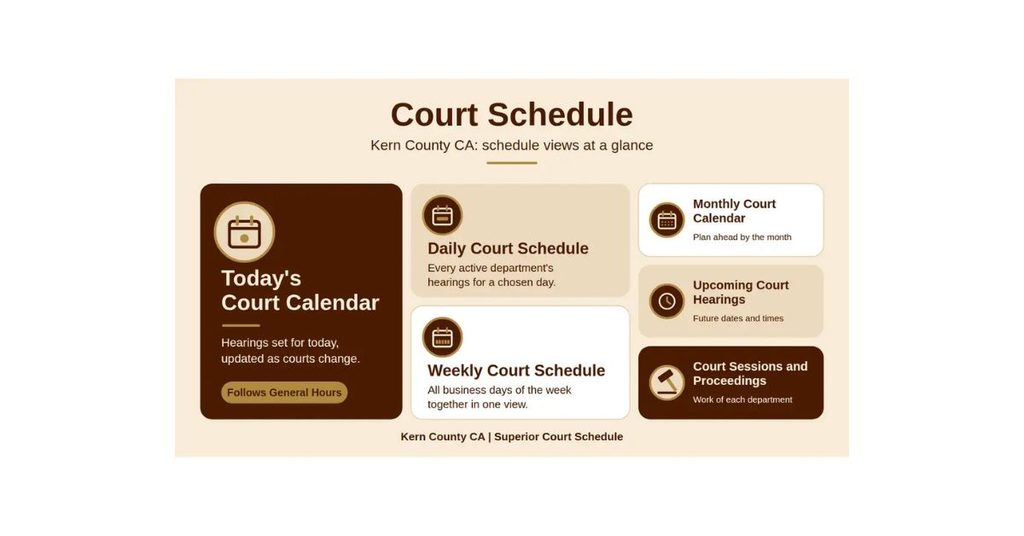
The Kern County court schedule runs every business day and follows the General Hours posted by the Superior Court. Each schedule reflects the work of every active department, so changes to one courtroom appear across the calendar without a manual refresh. Users see the same data clerks see from the bench, which keeps attorneys and self-represented litigants aligned. Below you will find the main schedule views available through the official portal and what kind of information each one shows.
Today’s Court Calendar
Today’s calendar displays every hearing set for the current business day at the Kern County Superior Court. You see the case number, party names, hearing type, time, and assigned courtroom on the same line. If a hearing was moved, canceled, or continued after hours, the calendar reflects that change first thing in the morning. This view helps you check for last-minute updates before leaving home or office.
Daily Court Schedule
The daily schedule view shows the next business day in detail once today ends. It includes the same data fields as the current day, plus a printable option for those who need a hard copy. Law offices use this view to prepare for the next morning’s hearings and confirm filing deadlines. The page also flags any hearings scheduled after 4:00 p.m. so users can plan around limited counter hours.
Weekly Court Schedule
Weekly schedule lists five business days of hearings on a single screen so users can see the full week ahead. Each day shows its own column of cases, judges, and courtrooms, which makes it easy to spot back-to-back hearings. This view helps attorneys plan multi-case weeks and helps parties avoid conflicts. The week view resets on Monday morning and runs through Friday afternoon.
Monthly Court Calendar
Monthly calendar view gives a 30-day snapshot of every scheduled hearing across all Kern County divisions. You can see peak hearing days and lighter days at a glance, which helps with travel planning. Each entry links to the case file so you can drill in for details. The monthly view updates whenever the court reassigns a case or moves a hearing to another date.
Upcoming Court Hearings
Upcoming court hearings view sorts the docket by the soonest future event first. You see the count of days until the hearing, the case type, and the courtroom assignment. This view is helpful when a party wants to focus only on what is next rather than second and back. The same view also shows hearings that were recently rescheduled, with the new date listed first.
Court Sessions and Proceedings
Court sessions and proceedings refer to the official blocks of time when a department conducts business. Each session lists the cases heard in order, the start time, and the recess schedule. Some divisions hold morning and afternoon sessions, while others run a single all-day block. The portal mirrors the published session structure so users see the same schedule the bailiff reads in the courtroom.
Hearing Information
Every entry on the Kern County court calendar carries a set of standard data fields that describe the hearing. These fields tell you what the case is, where to appear, and who will be on the bench. Reviewing these fields before you arrive saves time at the security checkpoint and inside the courtroom. The table below lists the core fields you see on a typical hearing record.
Hearing Date and Time
The hearing date and time field shows the exact moment the court plans to call your case. You should plan to arrive at least 30 minutes early so you can clear security and find the right courtroom. Kern County courts run on Pacific Time and adjust schedules when state holidays shift the calendar.
Courtroom Number
The courtroom number, sometimes called the department number, points to a specific courtroom on a specific floor. Signage inside the courthouse lists departments in numerical order to help visitors find the right door. Courtroom numbers also tell you which judge or commissioner is likely on the bench that day.
Court Location
Court location names the branch where the hearing will take place. The main Kern County courthouse sits at 1415 Truxtun Avenue, Bakersfield, CA 93301. Some hearings take place in satellite facilities such as the Metro Court or the juvenile building. The portal lists the full address so you can plug it into a map app.
Case Number
The case number is the official file label the court uses to track every filing, hearing, and ruling. It begins with a case type prefix such as “BCV” for civil, “CR” for criminal, “FL” for family, or “TR” for traffic. Numbers also include the filing year so older and newer cases stay separate. Always match the case number on your paperwork before relying on a calendar result.
Case Type
Case type tells you which division handles the matter and which procedural rules apply. Kern County separates cases into civil, criminal, family, probate, juvenile, misdemeanor, felony, and traffic divisions. Knowing the case type also tells you what kind of evidence or filings to expect at the hearing.
Hearing Type
Hearing type names the procedural event on the schedule such as arraignment, pretrial conference, motion hearing, or trial. Each hearing type carries its own purpose, paperwork, and timeline. Reading the hearing type helps you know whether you need to bring a witness, a check, or simply yourself.
Assigned Judge
The assigned judge field lists the judicial officer who will preside over the hearing. Kern County uses department numbers alongside judge names so you can confirm coverage even if a judge changes mid-week. Self-represented litigants often check this entry to read prior rulings by the same judge.
Hearing Status
Hearing status tells you whether the court confirms, rescheduled, canceled, or continued the matter. Status flags update on the calendar as soon as the clerk enters the change. A status of “confirmed” means the matter will go forward, while “continued” means the court moved it to a new date listed on the record.
Hearings by Case Type
Kern County organizes hearings by case type because each category follows its own set of rules and timelines. Civil cases move at a different pace than criminal cases, and family matters often follow yet another timeline. Knowing which case type you fall under helps you predict how many hearings to expect and what each one covers.
Civil Court Hearings
Civil court hearings cover disputes between people or businesses over money, property, contracts, or injury claims. These hearings include case management conferences, motion hearings, mandatory settlement conferences, and trials. Civil calendars often run longer than criminal calendars because discovery and motion practice take more time.
Criminal Court Hearings
Criminal court hearings cover matters where the state prosecutes a defendant for an alleged offense. These hearings include arraignments, pretrial motions, plea hearings, trials, and sentencing. The criminal division also handles probation modifications and post-conviction relief requests.
Family Court Hearings
Family court hearings cover divorce, custody, visitation, child support, parentage, and domestic violence restraining orders. Hearings may include status conferences, settlement hearings, and trials on contested issues. Family cases often appear on separate calendars from civil cases, with shorter time between hearings.
Probate Court Hearings
Probate court hearings cover wills, trusts, conservatorships, and estate administration. These matters include petitions for appointment, inventory reviews, and accountings. Probate calendars tend to move slower because many hearings depend on filings from attorneys or fiduciaries.
Juvenile Court Hearings
Juvenile court hearings cover dependency and delinquency matters involving minors. Dependency hearings address child welfare cases filed by social services, while delinquency hearings address charges against minors alleged to have broken the law. Juvenile hearings often take place in a separate facility to protect minor privacy.
Misdemeanor Hearings
Misdemeanor hearings cover lower-level criminal charges such as simple assault, petty theft, or first-time DUI. These hearings include arraignments, pretrial conferences, motions, and trials. Misdemeanor cases move faster than felony cases because the law caps possible penalties.
Felony Hearings
Felony hearings cover serious criminal charges such as aggravated assault, robbery, or drug sales. These hearings include preliminary hearings, pretrial motions, plea hearings, and trials. Felony cases often last several months from arraignment to sentencing because of the heavier procedural burden.
Traffic Court Hearings
Traffic court hearings cover infractions and certain misdemeanors such as driving under the influence. Hearings include arraignments, trial by declaration challenges, and bench trials. Many traffic hearings resolve in a single appearance when the driver pays the fine or completes traffic school.
Types of Court Hearings
Each calendar entry on the Kern County system names a hearing type that reflects its purpose. Understanding the purpose of each hearing helps you know what paperwork to bring and what to say when the matter is called. The following list covers the most common hearing types you will see on a Kern County calendar.
Arraignment Hearings
Arraignment hearings are the first court appearance in a criminal case. The judge reads the charges, confirms the defendant’s lawyer, and sets future dates. Defendants usually enter a plea of not guilty, guilty, or no contest at this stage. Most arraignments last only a few minutes.
Pretrial Hearings
Pretrial hearings address motions, discovery disputes, and plea negotiations before trial. The judge may hear arguments on suppression motions or other legal issues. Pretrial hearings help narrow the issues so the trial focuses on contested facts.
Motion Hearings
Motion hearings let either side ask the judge to rule on a specific request. Motions can cover anything from continuances to suppression of evidence. The moving party files a written motion, and the responding party files opposition paperwork before the hearing date.
Status Hearings
Status hearings check the progress of a case and confirm the next steps. The judge reviews filings by reviewing official felony records online registry, sets deadlines, and confirms trial readiness. Status hearings often last only a few minutes and require no testimony.
Trial Hearings
Trial hearings are the formal proceeding where each side presents evidence and witnesses. Trials can last a single day or several weeks depending on the case. The trial calendar sets firm dates that courts rarely move once the trial begins.
Sentencing Hearings
Sentencing hearings happen after a conviction or guilty plea in a criminal case. The judge considers probation reports, victim statements, and arguments from counsel. Sentencing can include fines, probation, county jail time, or state prison time depending on the offense.
Initial Appearances
Initial appearances are early-stage criminal hearings where the court advises the defendant of the charges and rights. The judge also reviews bail or release conditions. Initial appearances sometimes happen within 48 hours of arrest.
Case Management Hearings
Case management hearings keep a civil or complex case on track. The judge sets discovery deadlines, motion cutoffs, and trial dates. Parties must attend or risk sanctions such as dismissal or default.
Judge and Division
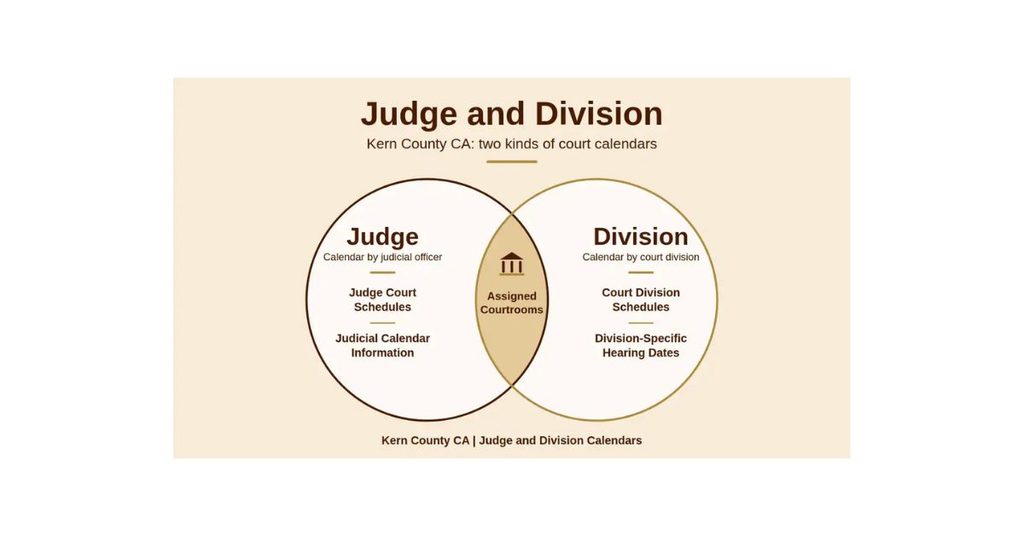
Kern County posts calendars by judge and division so you can see what each courtroom handles. Judicial officers and divisions both keep separate calendars because each one runs its own docket. Reviewing these calendars helps you track a specific case and prepare for the courtroom where it sits. Below is a closer look at how the judge and division calendars work.
Judge Court Schedules
A judge court schedule lists every case assigned to a specific judicial officer on a given day. You see the time slots, hearing types, and party names tied to that judge. Attorneys use this view to coordinate coverage, and self-represented litigants use it to track the judge assigned to their case.
Court Division Schedules
A court division schedule groups cases by division such as civil, criminal, or family. Each division lists the matters set for that day across all judges in the division. Division calendars help clerks balance caseloads and help visitors know which wing of the courthouse to visit.
Assigned Courtrooms
Assigned courtrooms tie each case to a specific department inside the courthouse. Department numbers correspond to physical courtrooms, and each one carries its own daily schedule. Knowing your assigned courtroom helps you find the right floor quickly when you arrive.
Judicial Calendar Information
Judicial calendar information covers the assignment of judges to divisions and courtrooms. Kern County reassigns judges as caseloads shift, and the calendar reflects those changes. You can review this information to confirm which judge handles a particular division on a particular day.
Division-Specific Hearing Dates
Division-specific hearing dates list only the hearings set within a chosen division. This view removes unrelated cases from the screen so you can focus on matters that match your case type. It also helps legal aid offices track hearing volume for reporting purposes.
Court Calendar Changes
Court calendars change for many reasons, from attorney scheduling conflicts to judicial reassignment. The Kern County system updates the calendar as soon as the clerk enters a change. Reviewing the latest status before your hearing protects you from showing up on the wrong day. The categories below cover the most common calendar changes you will see.
Rescheduled Hearings
Rescheduled hearings moved from one date to another at the court’s direction. The calendar shows both the original and new dates so you can track the change. Always read the status line to confirm the new date before making travel plans.
Canceled Hearings
Canceled hearings no longer appear on the schedule because the matter resolved or the court removed it. A cancellation often follows a settlement, dismissal, or plea. The calendar status line will read “canceled” and the entry may disappear entirely after the new date passes.
Continued Hearings
Continued hearings are cases the court moved to a future date to allow more time for filings or evidence. The new date appears on the calendar with a status flag of “continued.” The original date may still show on the record for historical reference.
Postponed Court Dates
Postponed court dates reflect delays granted to one or both parties. The court may postpone a hearing so a witness can appear or a lawyer can prepare. The new date appears once the clerk enters the order on the docket.
Changed Hearing Times
Changed hearing times reflect new clock times for a hearing that stayed on the same date. A hearing set for 9:00 a.m. might move to 11:00 a.m. if the morning calendar runs long. The status line will show the new time next to the case number.
Courtroom Changes
Courtroom changes shift a hearing from one department to another inside the same courthouse. The court may reassign a case if the original judge recuses or becomes unavailable. The calendar shows the new courtroom number next to the case entry.
Calendar Status Updates
Calendar status updates are general flags the clerk uses to mark changes such as “off calendar,” “dropped,” or “stipulated.” Each flag carries a specific meaning tied to local rules. Reading the status line carefully helps you understand why a case moved.
Locations and Hearing Access
Kern County operates several courthouse facilities, with the main courthouse at 1415 Truxtun Avenue in Bakersfield. Each facility runs hearings for specific divisions and case types. Knowing which building to visit saves you a long drive and missed appearances. The information below covers the practical details of getting to the courthouse and appearing at a hearing.
Court Building Information
The main Kern County courthouse sits at 1415 Truxtun Avenue, Bakersfield, CA 93301, and houses civil, criminal, family, probate, and traffic divisions. The Metro Court branch handles some arraignments and limited civil matters. The juvenile courthouse sits at a separate address to protect minor privacy.
Courtroom Locations
Courtroom locations follow the department number inside each courthouse. Department numbers appear on hallway signs and on the calendar entry next to each hearing. Court staff at the information desk can also point you to the correct room if you bring your case number.
Finding the Correct Court
Finding the correct court starts with reading your paperwork for the case type, division, and courtroom number. The calendar entry lists the same information in the same order. If the paperwork shows a satellite location, follow the directions on the calendar entry rather than the main courthouse.
Directions and Parking Information
Parking at the main Bakersfield courthouse is available in nearby public garages and metered street spots. Public transit routes serve the Truxtun corridor with stops close to the courthouse entrance. Allow extra time for security screening, which can add 15 minutes during peak hours.
Virtual Court Hearings
Virtual court hearings let you appear by video from a remote location using a court-approved platform. The court emails or mails instructions with a hearing link and a phone number for backup audio. Always test your camera and microphone before the scheduled start time.
Remote Hearing Access
Remote hearing access covers phone appearances and video appearances for matters the court allows to proceed that way. Not every hearing qualifies for remote access, especially trials. The calendar entry will note “remote” or “in person” once the court confirms the appearance method.
In-Person Hearing Requirements
In-person hearing requirements include valid photo ID, appropriate attire, and the absence of weapons inside the building. Phones must stay off in the gallery, and food or drinks are not allowed past the security checkpoint. Plan to arrive early to clear security and find your courtroom before the calendar is called.
Reading a Court Calendar
Reading a court calendar takes practice because each line uses shorthand codes that save room on the printed page. Once you know the codes, the calendar turns into a fast way to find hearing details. The following breakdown shows how to read each field on a typical Kern County calendar entry.
Case Number and Party Names
The case number sits at the start of each entry and identifies the file. Party names appear next to or below the case number, showing who is involved. The first listed party is usually the plaintiff or petitioner, and the second is the defendant or respondent.
Hearing Date and Time
The hearing date and time appear in a fixed column so you can scan the calendar quickly. Times follow the 12-hour format with “a.m.” or “p.m.” to avoid confusion. Pay attention to the time zone, which is Pacific Time for all Kern County hearings.
Hearing Type and Purpose
The hearing type appears next to the time and explains the purpose of the appearance. Common abbreviations include “ARR” for arraignment, “PTC” for pretrial conference, and “Mtn” for motion. The full name of the hearing usually appears in a key on the same page.
Judge and Courtroom
The judge and courtroom fields appear together because the two are tied. The department number often matches the courtroom number by reviewing official divorce legal records, which makes it easier to find the right door. If the judge changes, the courtroom number may also change, so read both fields before heading to the hallway.
Calendar Status
The calendar status line tells you the current state of the matter. Status codes include “C” for canceled, “R” for rescheduled, “H” for held, and “D” for dropped. The court posts a key at the bottom of the calendar that explains each code in plain English.
Court Calendar Abbreviations
Court calendar abbreviations save space and let clerks fit more entries on a page. Familiar codes include “JDG” for judge, “CRT” for courtroom, and “DEF” for defendant. The key at the bottom of the printed calendar lists every abbreviation used that day.
Missing or Unavailable Court Dates
Sometimes a hearing does not appear on the Kern County calendar even when you expect to see it. Several common reasons explain why a date may be missing, and each has a simple workaround you can try. The information below walks through the most common causes and the steps you can take to confirm the hearing.
Why a Hearing May Not Appear
A hearing may not appear on the public calendar for several reasons, including clerk processing delays, sealed records, or hearings set outside the standard search window. The portal only shows entries the clerk has finished entering. New entries may take up to 24 hours to appear.
Recently Scheduled Hearings
Recently scheduled hearings may not yet appear because the clerk has not finished entering them. The portal usually refreshes overnight, so a hearing set late in the day may not appear until the next morning. Try the search again the next business day before calling the clerk.
Recently Changed Court Dates
Recently changed court dates may still show the old information if the clerk has not posted the update. The calendar refreshes on a fixed schedule, so changes entered after the last refresh appear on the next cycle. Wait for the next refresh or call the clerk for confirmation.
Restricted or Confidential Hearings
Restricted or confidential hearings do not appear on the public calendar by law. Cases involving juveniles, sealed mental health commitments, and certain family matters fall into this category. Only parties to the action and authorized agencies can see those dates.
Calendar Update Delays
Calendar update delays happen during heavy filing periods, system maintenance, or emergencies. The court posts notices on the portal when maintenance is scheduled. If your search returns no results during a known delay, check back after the maintenance window closes.
Where to Confirm a Court Date
If you cannot find a date online, contact the Kern County Superior Court clerk at the main phone line or visit the clerk’s window in person. Bring your case number and photo identification. Court staff can confirm the date and pull any related paperwork you need for the hearing.
Contact Information
The following contact information can help visitors identify the relevant office and check its general operating hours before making an inquiry. These details are provided for reference, and visitors should confirm current contact information and availability through the appropriate official Kern County source.
- Official physical address: 1415 Truxtun Avenue, Bakersfield, CA 93301
- Phone: (661) 610-6000
- General Hours: Monday-Friday, 8:00 a.m.-4:00 p.m.
Frequently Asked Questions
The Kern County court calendar shows upcoming hearings, trial dates, and docket updates. Accessing this schedule helps attorneys, parties, and the public stay informed about court actions. By using the online portal you can find case numbers, judge assignments, and courtroom locations instantly. Knowing the schedule reduces missed appearances and saves time. The service is free, runs 8:00 a.m.‑4:00 p.m. on weekdays, and updates whenever clerks post new entries.
How can I search the Kern County court by case number?
Visit the Kern County Superior Court online portal and select “Case Information Search.” Enter the case number in the search box and click “Find.” The results display hearing type, date, time, courtroom, and presiding judge on one screen. You can print or download the details for records. This quick lookup works for any active case in the county.
Where do I find the Kern County CA for a specific judge?
On the same portal choose “Judicial Calendar” from the menu. Pick the judge’s name from the dropdown list, then set the desired date range. The page lists all hearings assigned to that judge, including case numbers and locations. Use the filter to narrow results by division or hearing type if needed.
What steps should I follow to view upcoming court dates for a particular division?
Log in to the online case search, click “Division Calendar,” and select the division (e.g., Family Law, Civil). The system shows a table of scheduled dates, times, and courtroom numbers. Review the list, note any conflicts, and contact the clerk’s office at (661) 610‑6000 for clarification. Export the table to keep a personal copy.
How do I locate the Kern County court calendar records for a past hearing?
Open the portal and click “Historical Calendar.” Input the hearing date range and, if known, the case number or party name. The search returns archived entries with full details, including outcomes and docket numbers. These records are useful for appeals or verifying past appearances. Save the PDF for future reference.
Can I receive email alerts for new entries on the Kern County court calendar?
Yes. After logging in, go to “Alert Settings” and enter your email address. Choose the criteria you want—case number, judge, or division. The system sends a notification whenever a matching entry is added or changed. Alerts help you stay ahead of schedule without checking the site daily.